Skip to content Skip to footer

Current research

CHIP III

We are proud to work with the Queens University Belfast and Congenital Heart Disease Intervention Programme (CHIP III).  The CHIP team have an internationally recognised track record of undertaking research that helps to better understand CHD.

A longitudinal research project began back in 2000 to see if a family intervention -Congenital Heart disease Intervention Programme (CHIP) – could help support better outcomes for children diagnosed with CHD. Those children are now adults. We recently followed up with them to see how they are doing. This was the third wave of the project, CHIP III. Preliminary findings from CHIP III have been presented to participants, their families and medical staff. Together, their feedback will inform the future of this research, and ultimately interventions for children with CHD and their families, to help them reach their full potential at each stage of development.

  • Fifty-three participants took part in CHIP III.
  • Preliminary findings suggest that the children of the families who received the intervention have better neuropsychological outcomes than those in the control group.
  • Both groups reported similar levels of self-reported psychosocial measures.
  • Fifteen parents of young people from our sample took part in two focus groups.

Summer Blast


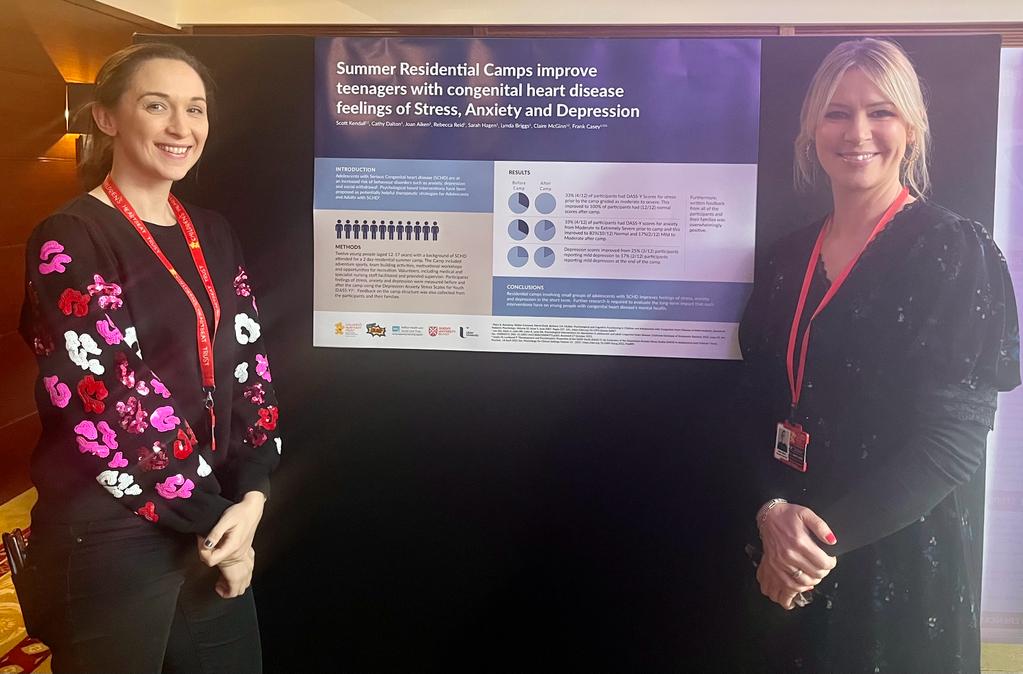
  • At Summer Blast 2023 we decided, for the first time, to measure the impact of Summer Blast using a more rigorous methodology.
  • A validated psychometric scale called the Depression, Anxiety and Stress Scale, Youth version (DASS-Y) was used to measure any gains attained over the course of the residential.
  • There was a 100% improvement in mental health scores taken at the beginning of camp to those taken at the camp’s end.
  • 33% scored moderate to severe stress at the start of the camp, compared to 0% with moderate to severe stress at the end.
  • 33% scored moderate to extremely severe anxiety at the start of the camp, 0% fell in the moderate to extremely severe category at the end.
  • Depression scores improved from 25% reporting mild depression at the start of the camp to 17% at the end.
  • The poster won third prize at the Young Investigators Award at the All Island Network Paediatric Cardiology Conference 2024.

Additional research